eLEARNING LOGIN
Course Prework
eLEARNING LOGIN
Course Prework

Hands-On Critical Care Airway Management Training for ICU Clinicians
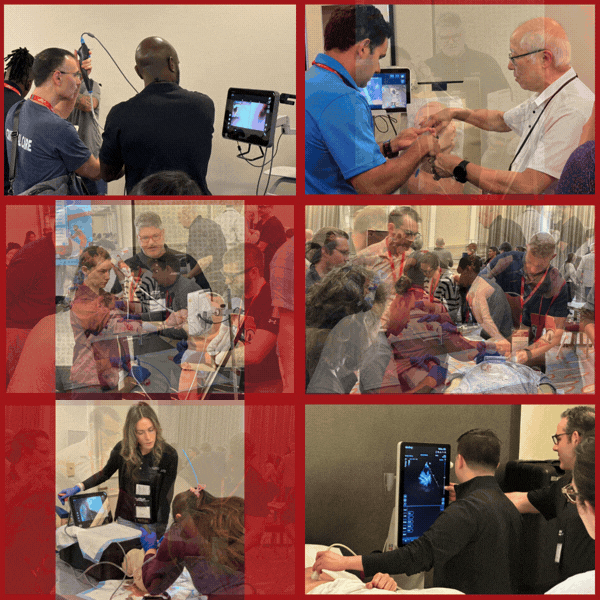
The Difficult Airway Course: Critical Care is a specialized, hands-on course focused on the physiologically difficult airway and ICU airway management of critically ill patients.
Designed specifically for providers caring for critically ill patients – intensivists, pulmonary and critical care physicians, hospitalists, nurse practitioners and physician assistants – this immersive course is the only national CME program applying the evidence-based airway management approach developed by Drs. Ron Walls, Michael Murphy and Robert Luten to the critical care environment. The course prepares clinicians to manage physiologically difficult airways, perform awake intubation, rescue failed airways and confidently execute surgical airway techniques when seconds matter.
When a complex airway presents in the ICU the stakes couldn't be higher. Hypoxia. Soiled airways. Hemodynamic collapse. In many hospitals you may be the most experienced airway clinician in the room, and you don't get a second chance to get it right.
The Difficult Airway Course: Critical Care is designed to prepare you for exactly these moments with:
- Hands-on Training and Expert Insights
- Core content, advanced airway strategies and evidence-based approaches delivered through a dynamic blend of focused discussions, case-based teaching and hands-on practice in essential airway techniques.
- Practical Strategies and Techniques You Can Use Immediately
- You'll get guided, hands-on reps with multiple devices working with our expert faculty, and leave with the confidence to apply these vital skills on your very next shift!
- Realistic, High-Stakes Simulation
- Our high-fidelity Code Airway™ stations put you directly in the scenarios you'll face bedside, providing a risk-free environment to practice applying the strategies and skills you've learned.
Reserve your seat below. | See Sample Schedule | Frequently Asked Questions
Upcoming Dates and Locations
Course Fees:
We understand that plans can change for many reasons, resulting in the need to change your registration. To ensure fairness and transparency, we’ve developed policies that are as accommodating as possible. Our Cancellation and Transfer policies are summarized below – please click here to see the full text of these.
Cancellation
The following fee schedule applies to all cancellations regardless of the reason for cancellation:
- Cancellations requested 14 days or more prior to the course start date will receive a 90% refund
- Cancellations requested 2 – 14 days prior to the course start date will receive a 50% refund
- No refunds will be issued for cancellations requested within 2 days of the course start date, or to registrants who do not attend the course and fail to make prior arrangements to change their registration.
Transfer
Alternately, registrants may transfer their registration with a 100% tuition credit under the following terms:
- Transfers requested more than 7 days prior to the course start date may be transferred with no fee.
- Transfer requested within 7 days of the course start date will be charged a $200 Administrative fee.
- Transfer credits are valid through December 31 of the calendar year following the transfer request.
All cancellation and transfer requests must be made in writing to registrations@theairwaysite.com before the start of the course.
AMEC does not waive the fees outlined above due to natural disasters, weather-related problems, travel delays, government shutdowns or similar events beyond our control.
In the unlikely event AMEC is required to cancel a course, all attendees will receive a 100% refund or may transfer to another course.
Amazing course! Every doctor involved with airway management should take this course. I can clearly assess my strengths and my weaknesses, I feel well prepared to approach the most challenging airways. The hands-on experienced is key to this course! Thank you for a well-organized and enlightening course!
You guys knocked it out of the park! Not only was the course highly informative and empowering, but fun and enjoyable as well.
I loved the warmth and passion of the instructors. Great group and very accessible. Easily one of the best, most practical and fun CME courses I have had in a long time.
Airway Management in the ICU is Different
The ICU is home to some of the most challenging airway scenarios in medicine. Unlike the controlled environment of the OR or the unpredictable nature of the ED, the ICU lies somewhere in the middle; critically ill patients often deteriorate quickly, with severe hypoxemia, shock, hemodynamic instability and dynamic physiology leaving little margin for error. From self-extubation and tracheostomy emergencies to awake intubations and the massively soiled airway, success demands more than technical skill. It requires a structured, evidence-based approach to the physiologically difficult airway and the confidence to make rapid decisions when seconds matter.
At The Difficult Airway Course: Critical Care You’ll Learn To:
Featuring a dynamic and interactive learning environment, The Difficult Airway Course: Critical Care is built for clinicians practicing in environments where airway opportunities are infrequent – but high risk – and backup may not be immediately available.
High-Stakes Skills You Will Master:
- Preventing Physiologic Collapse
- Preoxygenation strategies
- Hemodynamic optimization
- Managing the physiologically difficult airway
- Maximizing First-Pass Success
- Optimizing view with video laryngoscopy
- Positioning for critically ill patients
- Airway Ultrasound
- Managing the Failed Airway
- Rapid transition to rescue strategies
- Supraglottic airway use
- Avoiding repeated unsuccessful attempts
- Performing Life-Saving Rescue Techniques
- Surgical airway as part of the plan – not a last resort
- Emergency oxygenation strategies
- Extubation techniques and use of Airway Exchange Catheters
- Leading the Airway Emergency
- Crisis decision-making frameworks
- Team leadership and communication
- Code Airway scenarios including:
- Agitated hemodynamically unstable patient who self-extubates
- The bleeding, traumatized, vomit-filled airway
- Tracheostomy issues, including accidental dislodgement
- Upper airway obstruction
- The “can’t intubate / can’t ventilate” situation
- Airway management in the massively obese patient
Endorsed By:
Frequently Asked Questions
Q: Who should attend The Difficult Airway Course: Critical Care?
A: The Difficult Airway Course: Critical Care is designed for clinicians responsible for airway management in critically ill adult patients. The course is ideal for intensivists, pulmonary and critical care physicians, hospitalists, critical care nurse practitioners, physician assistants, respiratory therapists, and any provider who manages or assists with high-risk airway emergencies.
The course is particularly valuable for clinicians practicing in community hospitals, rural facilities and other settings where airway opportunities may be infrequent and expert backup may not be available.
Q: Is this course appropriate for hospitalists and advanced practice providers?
A: Yes! The difficult Airway Course: Critical Care is valuable for all members of the patient care team practicing in the ICU / CCU.
Q: Will I learn surgical cricothyrotomy?
A: Yes! The Difficult Airway Course: Critical Care features a dedicated session teaching surgical cricothyrotomy with a short introduction lecture covering key concepts, and hands-on time practicing surgical airway techniques on pig tracheas, providing a “real feel” environment to fine-tune this life-saving skill.
Q: Does the course teach awake intubation?
A: Yes – awake tracheal intubation is an important piece of every clinicians’ airway toolbox, and The Difficult Airway Course: Critical Care teaches how to recognize when this approach should be used, as well as best practices for awake tracheal intubation.
Q: How much simulation is included in the course?
A: The Difficult Airway Course: Critical Care features 5 hours of Code Airway™ scenario sessions. Attendees are broken into small groups and rotate through a variety of real-world scenarios designed to highlight and reinforce the approaches and techniques taught during the course.
Q: Is CME Credit available?
A: Yes! The Difficult Airway Course: Critical Care is approved for CME credit by ACCME through our joint providership with SCP Health.
SCP Health designates this live activity for a maximum of 20 AMA PRA Category 1 Credits™. Click here for full accreditation information.
Q: What difficult airway scenarios are practiced?
A: Our two Code Airway™ sessions cover scenarios derived from actual patients and airway issues our faculty have experienced in their practice. Situations range from awake intubation in cooperative patients to extreme physiologically difficult airways, cardiac arrest airways, soiled airways, blown cuffs, accidental extubation, hemorrhagic shock and more! These sessions require attendees to work together to run through the assessment and decision-making processes taught at the course and apply the techniques they’ve practiced to resolve each case.
Q: What is included in the course tuition?
A: Course tuition includes the course textbook, Manual of Airway Management in Critical Care, 1st edition
(© 2024 Wolters Kluwer) and The Airway Card™.
Accreditation
Schedule Download PDF
2020 Typical Course Schedule (final schedule distributed on-site)
Day 1
6:30 - 7:30 AM
Registration and Breakfast
7:30 - 8:00 AM
Introduction/Setting the Scene
8:00 - 8:30 AM
Essential Skills in Airway Management
8:30 - 9:00 AM
Airway Anatomy
9:00 - 9:15 AM
Fiberoptic Tour of the Airway
9:15 - 9:30 AM
Break
9:30 - 10:00 AM
Difficult Airway Assessment / Difficult Anatomy
10:00 - 10:30 AM
Dangerous Physiology in Emergency Airway Management
10:30 - 11:15 AM
RSI Pharmacology
11:15 AM - 12:15 PM
Workshops I:
Hands-on: Essential Techniques in Airway Management
Hands-on: Topical Anesthesia, Fiberoptic Bronchoscopy, Video Laryngoscopy
12:15 - 1:15 PM
Panel Lunch
(box lunch provided)
1:15 - 2:15 PM
Workshop I:
Hands-on: Essential Techniques in Airway Management
Hands-on: Topical Anesthesia, Fiberoptic Bronchoscopy, Video Laryngoscopy
2:15 - 3:00 PM
Human Factors I
3:00 - 3:15 PM
Break
3:15 - 5:15 PM
Workshops II:
Hands-on: Tips and Tricks (More Essential Techniques)
Hands-on: Combining Fiberoptic Bronchoscopy and Video Laryngoscopy or EGD
Day 2
6:30 - 7:30 AM
Registration and Breakfast
7:30 - 9:30 AM
Workshops III:
Hands-on: Emergency Surgical Airway
Hands-on: Soiled/Trauma Airway
Workshop: Airway Ultrasound
Workshop: Special Populations (Pediatrics, OB, Neuro)
9:30 - 9:45 AM
Break
9:45 - 11:45 AM
Workshops IV:
Hands-on: Emergency Surgical Airway
Hands-on: Soiled/Trauma Airway
Workshop: Airway Ultrasound
Workshop: Special Populations (Pediatrics, OB, Neuro)
11:45 AM - 1:00 PM
Lunch on Own
1:00 - 2:00 PM
Failed Airway
2:00 - 2:30 PM
Human Factors II
2:30 - 2:45 PM
Break
2:45 - 5:15 PM
Code Airway™ Simulations
Day 3
6:30 7:30 AM
Registration and Breakfast
7:30 - 8:00 AM
Extubation and Airway Exchange Catheters
8:00 - 8:30 AM
Organizational Considerations
8:30 AM - 10:30 AM
Workshops IV:
Post-Op Head and Neck, Tracheal Lesions and Stents
Hands-on: Extubation and Exchange Catheters
10:30 - 11:00 AM
Final Points and Pearls
11:00 - 11:30 AM
Wrap Up: Course Take-Home Messages, Interactive Exam
Course Objectives
Target Audience
Intensivists, Hospitalists, Respiratory Therapists and Critical Care Transport providers.
Endorsed by: